For years, m365.cloud.microsoft served a simple but critical role as the central place to start the workday. Users could orient themselves on recent activity across files, regardless of storage location in Microsoft 365, and decide where to go next without friction and without being forced into a single workflow. That experience has been gone for some time now as the “start of day” surface has been entirely overtaken by Copilot chat. To nav transforming what was once a navigational hub into an AI-first interaction space. While Copilot has value, its over emphasized dominance has removed a foundational layer of the Microsoft 365 experience: helping users quickly act on their work, not just talk about it.
The result? Users are now being implicitly pushed into OneDrive where we can add shortcuts to SharePoint Online libraries (also in Teams) as the new default place to begin the day. This was functional temporarily, though recent user interface changes in OneDrive search (aligned with Copilot search experience) have now rendered it unusable for the most common user actions.
OneDrive has been promoted without being prepared
Elevating OneDrive to the role of primary workday entry point raises the bar for usability, predictability, and task efficiency and recent changes have moved OneDrive in the opposite direction. In its current state, OneDrive search is functionally incomplete for common, high-frequency file management tasks. When searching for a file in OneDrive:
- You can no longer copy or delete it directly from search results.
- Core actions are hidden unless you navigate to the file’s original location.
- Once redirected, users often must search again, only for the file to open immediately, removing the opportunity to act on it at all.
This is not a minor inconvenience. It breaks the flow of work completely. Watch the video.
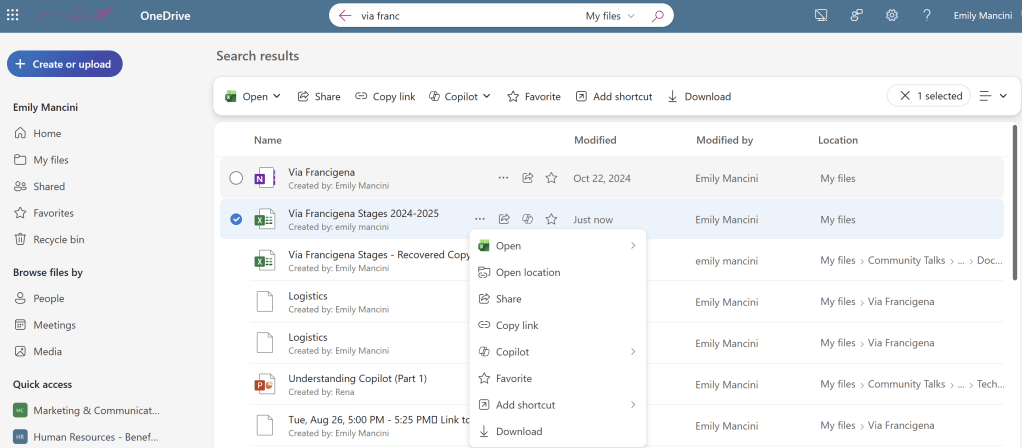
The problem doesn’t stop at OneDrive. It’s now in Microsoft 365 Copilot Search and inconsistent with SharePoint libraries.
What makes this more concerning is that search from m365.cloud.microsoft now behaves the same way as search in OneDrive, inheriting the exact same limitations.
In other words, even if users attempt to bypass OneDrive and start from what used to be the workday entry point, they encounter the same broken interaction model:
- Search results surface files without exposing core actions
- The context menu (accessed from the ellipses next to a file name) is functionally reduced
- Users are forced into file locations just to complete basic tasks
This effectively means that Microsoft’s top-level search experience now leads users into dead ends, where discovery is possible but the most commons actions are not. Search has become a navigation tool rather than a productivity tool by showing users where something lives but not allowing them to do anything meaningful with it.
At this point, the issue is no longer isolated to OneDrive. It reflects a broader product decision that treats search as a read-only surface, fundamentally misaligned with how knowledge workers actually operate.
A breakdown of basic UX principles
From a user experience standpoint, these changes introduce several serious issues:
- Broken task flows: Users are forced out of the search context, disrupting momentum and increasing task time.
- Loss of action affordances: Search results no longer expose essential file actions, reducing discoverability and user control.
- Redundant effort: Users repeat searches simply to perform basic operations.
- Increased cognitive load: Instead of focusing on the task, users must manually search for files when redirected to the location, or even worse, remember file locations which defeats the entire purpose of unified search.
In practice, this makes both OneDrive and Microsoft 365 Copilot Search unusable for routine operational behaviors, especially now that users are being nudged to start their day there.
Inconsistency makes it worse
Compounding the issue is a growing divergence between OneDrive and SharePoint document libraries, even though users move between them constantly.
The same file behaves differently depending on where it’s accessed:
- The ellipsis menu exposes different actions
- The top command bar changes in structure and capability
- Familiar actions appear, disappear, or move without clear rationale
This breaks consistency and transfer of learning, two foundational usability principles. Users can no longer rely on prior experience to predict how the interface will behave. Instead, they must pause, reassess, and relearn every single time the context shifts. That friction adds up quickly, especially in enterprise environments where efficiency matters.
AI is being optimized at the expense of real work
It’s clear these changes are driven by a desire to reduce visible actions and promote Copilot-assisted interactions. This reflects a recurring mistake Microsoft is making that I cannot stay silent about as they are optimizing for aspirational and perceived behaviors rather than actual ones. Most users do not need Copilot to (and frankly, I have never met one who would use it to) copy a file, delete outdated content or move documents between libraries
These are high-frequency, mission-critical tasks, and deprioritizing them in favor of an AI-first experiences creates a mismatch between product direction and real-world usage. When AI becomes the default answer to problems users weren’t asking it to solve, usability suffers.
A step backward, not forward
From a UX perspective, the current experience represents a regression in:
- Efficiency of use
- Consistency and predictability
- Support for primary user goals
- Alignment with established mental models
Reducing surface-level actions can be valuable when it doesn’t remove essential functionality at the moment users need it most. If OneDrive and Microsoft 365 Copilot Search are going to replace the workday start experience, they must first succeed at the basics. Until Microsoft re-centers on how people actually work, rather than how AI wants to be used, the start of the workday will continue to feel slower, heavier, and more frustrating than it needs to be.
 Emily Mancini
2 Thoughts